Ukraine as a Catalyst for Human Rights Collaboration: A Crucial Matter in a Cruel Conflict

Av Cecilia Lundström - Publicerad den 7 april 2026

The symposium Ukraine as a Catalyst for Human Rights Collaboration took place on March 16th, 2026, and featured discussions between scholars, practitioners and partners of both the Human Rights Profile Area and the Raoul Wallenberg Institute. This article is based on conversations with Lena Halldenius, professor in Human Rights studies, coordinator of the Human Rights Profile Area, and co-coordinator of the symposium, and Karol Nowak, senior lecturer in Law and participant of the symposium. The conversations revolved around the role of human rights and Human Rights studies in relation to the escalating war in Ukraine, and how the symposium Ukraine as a Catalyst for Human Rights Collaboration – which is part of the symposium series Human Rights Dialouge – contributes to the human rights research and collaboration at Lund University.

As the escalating war between Ukraine and Russia has entered its fourth year of full-scale invasion, human rights are continuously violated, posing unceasing challenges in safeguarding the rights of everyone involved. At Lund University, the Human Rights Profile Area highlights important aspects of human rights in relation to the Ukraine war through a symposium. 

Human rights as a foundational part of discussing the Ukraine war

Human Rights research and collaboration in relation to the Ukraine conflict are very important. Lena Halldenius speaks of a current global securitisation of politics. ”War is spoken of from a security perspective today”, she says. “We see a political discourse where human rights become conditioned and subordinated to questions of security. Which is ill advised, because what kind of security agenda are we left with if that agenda does not adhere to or understand how human rights are impacted?”

Halldenius argues that Human Rights research can direct focus back to the questions of human rights, to combat a dangerous trivialisation of the matter. But Human Rights research can also constitute a critical eye on how security is allowed to trump other concerns. ”Human rights issues are very, very, obvious on the ground in Ukraine. But for those standing on the outskirts and looking in, it is easy to focus on other things. Security is an important subject, but it should not overshadow issues which victims of war live through daily.”

Karol Nowak, associate professor in Law and participant of the symposium, agrees. ”Human rights are not forgotten in the Ukraine war, but they become a little obscured outside of Ukraine. The fact that people are hurting and dying becomes a bit transactional in the general debate, despite human rights being a very visible concern for those actually in Ukraine”, he says. “But war crimes are being documented in Ukraine in a way we usually don’t see in conflicts, and that documentation will be used as grounds to prosecute people later. In that sense, human rights become the very foundation for justice in Ukraine.”

Halldenius sees a worrying trend of weakening respect for human rights and human rights systems. The authoritarian turn global politics has taken has started to disintegrate the rule-based order built on human rights, and she expresses that there is reason to worry if we are moving towards a power based order instead.

Without a Human Rights agenda, we enter a state of “might is right” instead of working towards delimiting human suffering, Nowak says. A Human Rights research agenda puts a framework around human rights and make them workable - they constitute a platform to lift human rights beyond the agreement “it’s horrible when people suffer”. That agreement in itself does not lead anywhere, but Human Rights studies develop it into something more concrete.

“We do have a way of working with and holding people accountable for the crimes they are committing on the battlefield”, says Nowak. “It’s not just wishful thinking, but we have a ground for liability due to the framework Human Rights studies create. Symposia like these are very important to highlight that this framework does exist and is way of working with this in a concrete way.” 

A symposium to create a dialouge

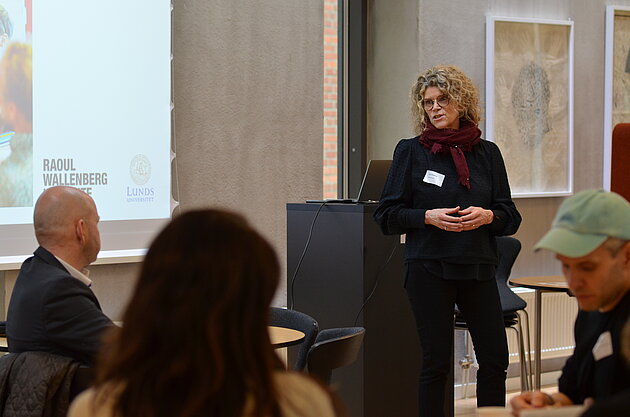
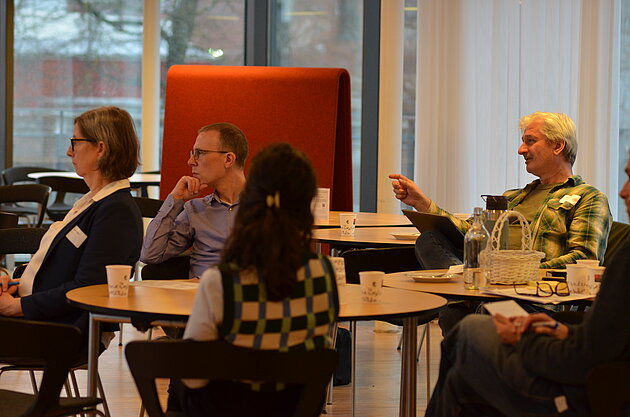
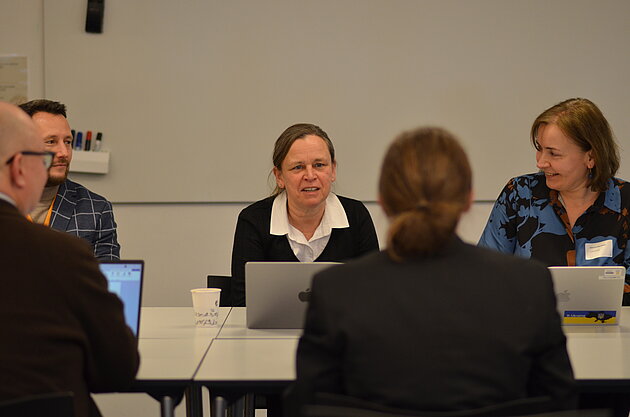
As snowdrops and crocuses began to bloom in the trenches outside Lund University, important research was conducted inside. The full-day symposium involved researchers and practitioners from various disciplines and generated fruitful conversations. Presentations were mixed with discussions on four topics: Access to justice, Disability rights, Conflict and disasters, and Good governance and business practices. 

“We could definitely have had more topics – the field is impossibly large and all topics are intertwined”, says Nowak. “But it needs to be delimited somehow, and these delimitations worked very well. Had the organisers taken on more topics, it would have been too much and unmanageable for a one-day symposium.”

Halldenius motivates the choice of categories with two factors.

“We wanted to discuss the war in a different sense than usually done”, she says. “The Ukraine conflict shows clearly how human rights are violated in different aspects in war. People who are already at risk of having their rights infringed, such as the disabled, becomes more affected in times of war. We wanted to put our focus there, instead of pointing towards the more ‘obvious’ things; such as war in itself being illegal and a violation of human rights.”

“The other reason behind the choice of these categories was that we wanted to align the discussion to the research already being done at the University. Those who have not studied Ukraine at all could still attend and contribute in a fruitful manner.”

But of course, other topics would have been interesting to explore. “The disastrous climate and environmental impact on war could be a topic to lift for the future. Another topic could be gender. Situations of war tend to aggravate already existing gender norms”, says Halldenius and points toward a problem lifted by both Halldenius and Nowak; returning Ukrainian war veterans.

Returning war veterans in Ukraine are often greeted as heroes, but they return ridden with PTSD. Their PTSD might make them violent and unstable, subjecting their families to danger. There is then sexual and gendered violence in the aftermath of the very war fought on the ground. But it’s not easy to hold these war veterans accountable – they did not ask for their PTSD, and being treated as heroes does not make it easier to point out how dangerous they are. They are heroes, victims, and perpetrators all at once, and constitute a ripple effect of infringed human rights outside the battle zone. “There are victims beyond those that get a bomb in their head”, says Nowak and points to ongoing dialogues, enabled by symposia like Ukraine as a Catalyst for Human Rights Dialogue, as very important to lift these kinds of non-obvious human rights issues.

Human rights studied or Human Rights studies? Academising human rights

Halldenius lifts the interdisciplinarity of Human Rights research as important. “People who hear about human rights usually thinks it’s about law or ethical principles”, she says. “Which it of course is, but we are focusing on the human rights challenges. Which are they? What kind of competences do we need to address them? With that perspective, it becomes obvious that it is not only about law or ethics”, argues Halldenius. “Rather than focusing on what human rights is, we look at what human rights do and how they can be threatened. If we look at the Ukraine war like that, we realise that human rights not only need lawyers and philosophers, but also engineers, climate scientists, healthcare staff and so on. That is the lens and the perspective that we bring to human rights and Human Rights research.”

This lens and perspective may prove very important to hold onto, as Human Rights research needs to be executed carefully. The biggest sin a human rights researcher can commit is to overly academise the ongoing infringements on human rights, argues Nowak. “We sit here in safe Lund, you know. Most of us have never been close to the Ukraine war or have any idea what it’s like to really suffer the consequences of it. And it is very easy for us to theorise ourselves into a position where we ‘explain’ to the victims what they really are going through. But that is incredibly insulting – these are people suffering and dying, and then some academics sit and reduce their suffering to a theoretical perspective.”

Nowak continues; “That really mustn’t happen. And it didn’t happen here. This symposium was very well coordinated and executed, and discussions were productive and thought-provoking.”

Nowak is overall very pleased with the symposium and wants that publicly acknowledged. “I have thanked the organisers in person already, but they should have a public thank you as well. This symposium exceeded my expectations – and I have high ones! I just hope they continue arranging these things in the future.”

Halldenius has good news for him. “We will continue doing these symposia, absolutely. The Human Rights Dialogue (a collaborative workshop format within the Human Rights Profile Area, author’s note) is a format for cooperate symposia, and most likely we will be able to do this annually. Ukraine as a Catalyst for Human Rights Collaboration was organised together with the Raoul Wallenberg Institute. This combination of practice-oriented, hands-on approaches and theoretical perspectives formed a very nice foundation for productive and fruitful dialogue, and it’s safe to say that our collaboration has worked very well.”

Amid peace deals, securitisation of politics, and weakened respect for human rights and human rights systems, Human Rights research and dialouges like these are more important than ever. Whilst the world hopes for long-lasting peace in Ukraine, the work of the Human Rights Profile Area and Raoul Wallenberg Institute continues to elucidate the problems of human rights infringements in a broad, and very important, manner.

__________________________________________________

Interviewed for and featuring in this article are Prof. Lena Halldenius and Ass. Prof. Karol Nowak.

Read more about the symposium here and here.

Read more about the Human Rights Profile Area here.

Read more about the Raoul Wallenberg Institute here.

Article written and interviews conducted by Cecilia Lundström in the spring of 2026. Images belong to the Human Rights Profile Area, Lund University.